tel.: 0670 537 8307

ZENIT MMORPG
Developing a serious online game has been an old plan of mine. For now Zenit started as a garage project. A large part of the world description was written long ago, and now I have reached the technical level to realize Zenit as an actual program.
ZENIT is a Flash-based online turn-based role-playing game, holding plenty of surprises even for connoisseurs of the genre. At the same time it tries to bring back the atmosphere of some old games. My focus won't be on stunning graphics or technical innovations, but on the gaming experience. While building it I am recalling all the games I used to play a lot. You won't need a fancy 3D card to run it - it will run on an average computer. Development itself is done on a mere 1.7 GHz tablet PC (at the moment).
Position: Game designer, Programmer, Graphic artist
Zenit MMORPG Flash AS3 /AIR program © 2007 Péter Vívó
Zenit role-playing world © 2000 Márton Székey Körmöczy, Germo
...under development
River View website
Client: Hilltop
The website of Hilltop's River View wine range, which is very popular in England too. I made it to accompany the material of their advertising campaign there.
Position: Programmer, Graphic artist
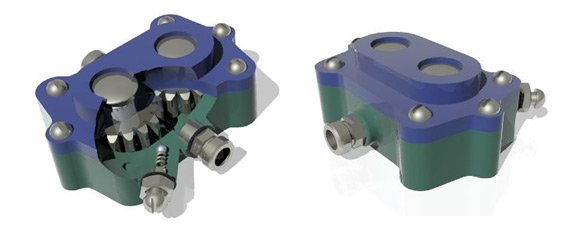
Pump assembly - interactive training material
Employer: Neting Kft.
An interactive training program running within the Neting framework. Following the assembly drawing, you have to put together a working pump.
As specified, you don't have to fit every part one by one: for example, when you attach the pipe stubs, the gaskets belonging to them also snap into place. Since it was an offline task, file size didn't matter much - it is about 1 MB.
Assembly order:One pipe stub, then the other, then the valve ball, spring, its gasket, nut, screw and so on ....
Position: Programmer, 3D Graphic artist
Slash animation editor
Client: Astra Zeneca
Link: szimbi microsite
My task was to build a microsite packed with more than 4 minutes of animation. Back then I didn't yet think of the FLV solution (which would have been much simpler), and making that much animation on the timeline didn't seem optimal either, so I chose the hardest path: I wrote an animation editor with a small built-in programming language, SLASH, with which I could control the elements of the microsite either from a console or from code.
Slash started out as a general-purpose program, but it was created specifically for the requirements of the Szimbi microsite, so it also has some site-specific commands, e.g.: menuIn, menuOut, keretIn, keretOut.
Slash of course also works online, but since I made the site for offline use, it has no direct database connection. You program it through the console. Commands are written one after another, separated by ,. If you put a single comma before the first command, the commands are placed on the timeline. If you start with 2 commas, they are executed immediately and not recorded.
,,stop stops the animation
,,0 sets the timeline to position 0
,,in,fiu the parameter of the in command is the mc named fiu (boy); it brings the selected mc - in this case a character - to the centre. From then on the character can be animated. The simplest way is realtime recording, which you start and stop by pressing F12. While the red "LED" is blinking, the program records every movement.
Example program: ,,stop,outAll,0,menuIn,in,fiu,in,kutya,button,kutya,url,www.swf.hu,end
Paste it into the console and hit enter: every character disappears, then the menu, the boy (fiu) and the dog (kutya) come in, and the dog is programmed as a button that jumps to swf.hu. The boy can be grabbed and animated, while the dog works as a button.
Keyboard shortcuts:
- SHIFT: scale the current mc up or down - move the mouse left and right
- CTRL: rotate the current mc
- F12: start/stop recording
- 0-9: select parts of the current character, e.g. the boy's eyes, mouth, hands, etc.
- Q-M: step through the frames of the selected limb of the current character.
- ..
Slash 0.1 command set
details later ..
- menuIn
- menuOut
- keretIn
- keretOut
- textIn
- textOut
- zeneKiBe
- menuRun
- text
- loopVolume [volume]
- volume [volume]
- stopLoop
- szinkron
- preLoad
- loop
- noise
- sound
- at ... endAt
- sappend
- sload
- wappend
- wload
- lib
- libnum
- label
- group
- groupAll
- tr
- mov
- zoom
- del
- cyk
- repm
- rep
- noBlink
- blink
- button ... end
- over ... roll ... end
- trb
- user
- user2
- url
- silence
- stop
- play
- cam
- camsen
- swap
- deep
- deepAll
- poz
- step
- in [mc] :: brings the mc with the given name onto the stage
- sel
- inAll :: brings every mc onto the stage
- out
- outAll
- top
- +
- -
- +-
- go
- st
- lock
- unlock
- load
- append
- build
- flip
- save
- saveLine
- savePure
- mask
- startGame
- callGame [game]
- loadGame [name , x , y , zoom]
- unloadGame
- Keyboard:
Position: Programmer, Graphic artist
ELDA - Electronic Learning and Drawing Application
Client: Matáv
This was my first serious program, and I relied heavily on the XML experience I had gained while developing the hangman game. The brief called for an online drawing program whose interface had to change dynamically depending on the environment it was used in. That's why I loaded the GUI elements from an XML database, so I could create a separate GUI XML for each environment.
The graphic data was also stored in an XML generated dynamically while drawing, which after speed optimization gave satisfactory results - as the concept required the data to be sent in real time to the hosting JavaScript for further processing.
Position: Programmer